Capital
Intelligence
Executing in the Market. The second volume — four proprietary execution frameworks and the institutional confluence stack that governs how they are applied together.
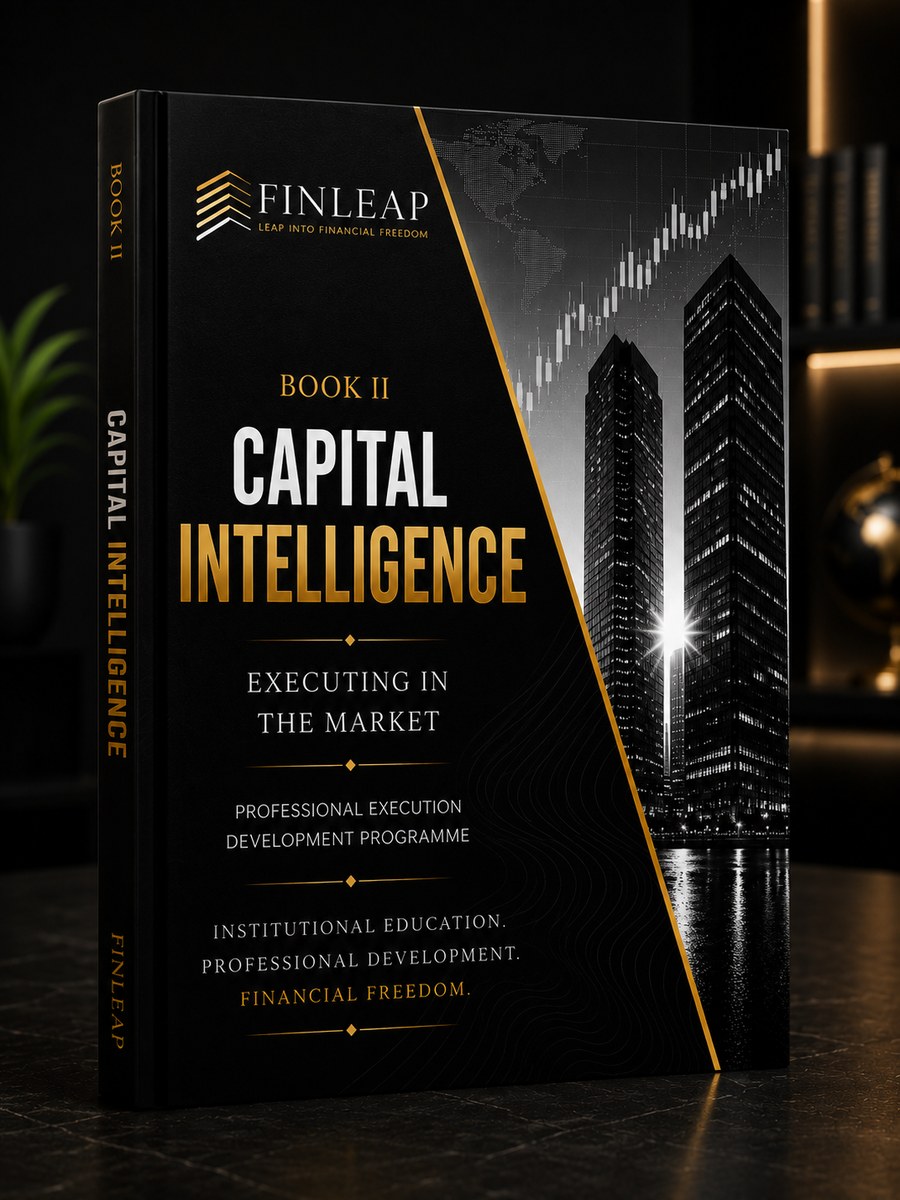
From “what is the market doing” to “how should I execute”.
Volume I taught you to read the market. Volume II teaches you to act within it — with structure, precision and defined criteria.
Four execution frameworks are introduced in sequence: the Institutional Order Block Framework, Candle Range Theory, the Liquidity Velocity Engine, and the Opening Range Breakout. The final chapter brings them together into the FinLeap Institutional Confluence Stack.
Volume II is issued alongside Volume I at your first session and is included in the programme fee.
Four frameworks. One confluence stack.
Order Blocks
Identifying the areas where meaningful institutional activity may have originated — and how to enter around them.
Candle Range Theory
Accumulation, manipulation and distribution within a defined range, and the models that follow from each.
Liquidity Velocity Engine
Build-up, sweep, displacement and momentum confirmation — reading commitment rather than guessing at it.
Opening Range Breakout
Asia, London and New York sessions. Define the range, wait for confirmation, execute only when criteria are met.
On completing Volume II, you will be able to:
- Distinguish analysis from execution and act on the difference
- Identify valid order blocks and avoid the common errors
- Apply CRT accumulation, manipulation and distribution models
- Read liquidity velocity: build-up, sweep, displacement
- Execute session-based ORB setups across three market opens
- Combine frameworks using the Institutional Confluence Stack
- Conduct multi-timeframe analysis before committing capital
- Place stops and define exits to a repeatable model
- Scale in and out, and manage an active position
- Review performance and iterate on your own process
“Professional execution is not about finding more trades. It is about making better decisions with the opportunities you are given.”
Six chapters.
From Analysis to Execution
- The Transition from Institutional Foundations
- Understanding Capital Deployment
- Analysis vs Execution
- Building an Execution Mindset
- The Anatomy of a Professional Trade
- The FinLeap Execution Process
Institutional Order Block Framework
- Understanding Order Blocks
- Bullish Order Blocks
- Bearish Order Blocks
- Identifying Valid Order Blocks
- Order Blocks & Market Structure
- Order Blocks & Liquidity
- Order Block Entry Framework
- Common Order Block Mistakes
Candle Range Theory (CRT)
- Introduction to Candle Range Theory
- Understanding the Candle Range
- Candle High & Candle Low
- Liquidity Within the Range
- CRT Accumulation
- CRT Manipulation
- CRT Distribution
- Bullish & Bearish CRT Models
- CRT Execution Framework
Liquidity Velocity Engine (LVE)
- Introduction to LVE
- Understanding Liquidity Velocity
- Liquidity Build-Up
- Liquidity Sweep
- Displacement
- Momentum Confirmation
- LVE Entry Framework
- LVE Trade Management
- Common LVE Mistakes
Opening Range Breakout (ORB)
- Understanding the Opening Range
- Why Market Opens Matter
- The FinLeap ORB Framework
- Asia ORB
- London ORB
- New York ORB
- ORB Breakout Confirmation
- ORB Re-Entry Model
- False Breakouts & Liquidity Sweeps
- ORB Trade Management
Institutional Execution & Capital Management
- Building the Complete Trade Setup
- The FinLeap Institutional Confluence Stack
- Multi-Timeframe Analysis
- Entry Models
- Stop Loss Placement
- Take Profit & Exit Models
- Scaling In & Scaling Out
- Managing an Active Position
- Execution Psychology
- Performance Review
- Continuous Improvement
What is assessed.
- Framework fluency — correct application without prompting
- Confluence discipline — waiting for criteria rather than forcing setups
- Execution consistency — the same process under pressure
- Review practice — honest post-trade analysis
Certification on capability.
The programme concludes with a final competency review spanning both volumes. Certification is issued on demonstrated capability, not on hours attended.
Graduates join the FinLeap alumni community and retain access to ongoing professional development.
Begin with a consultation.
A 30-minute conversation to understand your objectives and determine whether the programme is the right fit. No obligation.